
Found this blog and enjoy it very much...
A Guide to Self-Reliance Minimalism
by JEFFREY TANG on OCTOBER 13, 2009
I never considered myself a minimalist. I’ve always been a fan of efficiency, of not wasting time or resources, but I always resisted labeling myself as a card-carrying member of the minimalist club.
Looking back, I think my resistance boiled down to this: I hadn’t taken the time to own minimalism. To change the lighting, move the camera, and find a minimalism that was uniquely mine.
Today I found it. And it wasn’t even on purpose.
It just so happened that today two wonderful articles on minimalism appeared in my RSS reader:
Unautomate: Why doing things by hand forces minimalism – from mnmlist.com
Go Small Or Go Home: In Praise of Minimalism – from The Art of Manliness
If you have some time, please check these posts out. Even if you’re not a minimalist. Or a man.
It’s strange and amazing how things can come together at just the right time. I read these two articles in quick succession, and suddenly things clicked. I had one of those moments of crystal-clear, heart-pounding insight. But before I explain what I realized, I need to tell you something about myself.
I am a huge – HUGE – believer in the potential of individual people. Individual people do great things every single day, beating the odds and the critics all at once. You and me and the human spirit – we’re amazing. I could go on all day about this. I could even write an entire blog about it … oh wait.
Anyway, as I was saying, I had an incredible, mind-blowing, everything’s connected insight, boiling down to this:
Minimalism is the greatest possible tribute to the power of you.
Here’s what I mean.
As with any idea, there are different types of minimalism. It can be focused on reducing clutter. On streamlining finances. On being a real man – or woman, for that matter. And these are all great ways to think about minimalism. But they’re not for me. They’re not my way. They don’t make me get up on a soapbox and annoy my friends about them.
For me, minimalism comes from a rock-solid, unshakable, 100% belief that you are enough. That’s what “self-reliance minimalism” is to me.
“Thinking about men I admired, it dawned on me that most had a quiet contempt towards any excess of material possessions. Their expertise and confidence were displayed by the fact that they did not require much to live successfully.” – from “Go Small Or Go Home”
It means:
Having a conviction that you don’t need stuff to survive or succeed.
Knowing that you don’t need to hide behind convolutions and equivocations.
Knowing that your own mind and body are your two greatest, unlimited, inexhaustible, and infinitely renewable resources.
Having the courage to say, “I don’t need this to get me where I’m going.”
Never, ever allowing your potential to go to waste.
Getting rid of anything that gets in the way of YOU doing great things.
Now all this may lead to things like clearing clutter, reducing friction, and buying less, but for me, what’s most important is where all these actions come from. That’s what motivates me.
Becoming a Self-Reliance Minimalist
“Making things harder isn’t a bad thing. When we must do things ourselves, and it costs us in time and effort, it forces us to consider whether it’s worth doing at all.” – from “Unautomate”
If you’ve read this far, you know that this is something that clicked for me today. It’s new territory for me. I haven’t had time to test it or refine it – which is great, because instead of preaching about it, I’ll need to actually live it.
Will you help me put this into action? Here’s what I’m trying to do:
Focus on acquiring abilities, not tools. Instead of buying a bunch of gadgets to help me get a job done, let’s spend more time learning the skills behind the job. Tools are just things, but skills become part of us.
Get out of the “just in case” trap. Let’s stop hoarding stuff (money, books, guarantees, etc.) in the name of “What if?” and have the courage to rely on our ability to deal with crises.
Save with a purpose. Instead of saving money (or energy) just because someone said it was a good idea, let’s save with a clear goal in mind. Let’s spend less money now, with the express intent of using it on something specific later. Let’s save energy here, so we can make better use of it there.
Get rid of the redundant. Minimalism is usually about getting rid of the unnecessary. I say get rid of the redundant. Remember, your primary resource is yourself. Toss anything that simply repeats your own abilities.
Learn to trust yourself. To me, getting rid of stuff is an act of extreme self-confidence. It’s a declaration that, whatever happens, you can face it – and conquer it – without a bunch of stuff to hide behind.
Wednesday, October 14, 2009


Wednesday, October 7, 2009
Shred it

I've been organizing a busy office in San Francisco and one of the chores no one wants to do is the shredding. Let's face it, it's a drag to stand at a shredding machine for hours at a time, not to mention the noise the darn machines make.
Part of the problem is having the wrong shredder for the job. Most shredders sold at your local office supply store do not hold up to the mountains of papers that need to be shred. Just about any shredder under $200 is useless in an office setting. Besides paper it has to be able to handle staples and the occasional paperclip that slips through the sorting process. Many companies need plastic and discs shredded as well. So, when shopping for a shredder, buy the best you can afford for heavy duty shredding. Don't forget to buy the oiled sheets that are needed to keep the blades lubed.
If you have a box or more of papers to be shred, you've got some other options to standing over the shredder. You can take your boxes to a shredding company and in a matter of minutes they shred them right in front of you. My favorite is Automatic Response Systems in Berkeley. ARS also offers a "bin service", they bring the shredder and pick up your shredding for about .37/pound.
You can also call a shredding company to come to your home or office and shred your papers right in their truck. Just search for "mobile shredding companies in ...." and you'll get an idea of who to call in your city.
What ever you do, don't forget to recycle all that glorious shredded paper.
Wednesday, September 30, 2009
How to store paper...
While pads of paper or bound paper can stand vertically, all loose paper needs to be stored horizontally. There are several ways to do this successfully, depending on your space. Stacking letter trays may be "old school", but they work. Boxes can keep quality paper clean and wrinkle free and be neatly stacked on a shelf.


Wednesday, September 23, 2009
Organizing your office
Whether you work from home or off-site, if you are trying to grow your business and do your best work, I urge you to take a good look around your office and ask yourself if it is supporting your goals.
Do you look forward to going into your office everyday?
Do you know where to find the things you need in short order?
Do you feel comfortable having others come into your office?
Does your office support your growth or hold you back?
Is your office performing at the same level you are?
If you are answering NO to any of these questions, then it's time to organize your office. Many of us have offices that look like this one.

The desk drawers are stuffed...

While the cabinets are under utilized...
What did we do to get this office unstuck? We gathered all the papers and whatnots and separated them into categories. We separated the current/active files from the old/dead files. We removed anything that did not belong in the office. Then we reassigned homes to all items that were left.

We used some organizing supplies to keep items separated and easily available in the drawers.

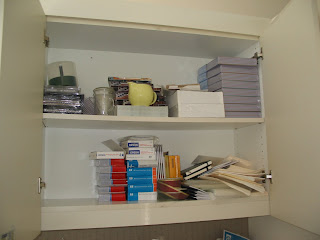
We utilized the over head cabinets for marketing materials and client supplies.

Our client was thrilled with the results and can now concentrate on growing the business, with confidence!
Do you look forward to going into your office everyday?
Do you know where to find the things you need in short order?
Do you feel comfortable having others come into your office?
Does your office support your growth or hold you back?
Is your office performing at the same level you are?
If you are answering NO to any of these questions, then it's time to organize your office. Many of us have offices that look like this one.

The desk drawers are stuffed...

While the cabinets are under utilized...

What did we do to get this office unstuck? We gathered all the papers and whatnots and separated them into categories. We separated the current/active files from the old/dead files. We removed anything that did not belong in the office. Then we reassigned homes to all items that were left.

We used some organizing supplies to keep items separated and easily available in the drawers.

We utilized the over head cabinets for marketing materials and client supplies.

Our client was thrilled with the results and can now concentrate on growing the business, with confidence!
Wednesday, September 16, 2009
The art of hanging art

Toni Berry, of Marie Antoinette Interiors, answers our questions about hanging art:
Q. Toni, we are really struggling with hanging our artwork. Can you give us some tips?
A. Yes, I certainly can.
Hang things closer together rather than farther apart. I often use the width of the frames as the spacing between pieces, and very rarely hang pictures more than two inches apart.
Hang things lower rather than higher. In general, artwork should be hung so that the center point of the picture, or grouping, is at eye level for the average person. (5 1/2 feet from the floor is the "universal" eye- level height).
Don't get stuck in the rut of hanging all of your art in a predominately horizontal arrangement. Create interest and visual excitement by hanging several pieces in a vertical "stack". When hanging 2 pieces one under the other, go for the unexpected - hang the larger piece above the smaller one to avoid a "bottom heavy" look. Or try propping a piece against a wall or mantel, not hanging it at all, this works great for mirrors too!
Relate artwork to the furniture below it. When hanging art over a table or sofa, for instance, the bottom of the frame should sit within 4-8" of the furniture below and its width should be less than that of the furniture.
Bigger is often better even in small spaces. One large painting can make a real statement, keep things simple, and draw attention to a room's focal point, like a fireplace or sofa.
Still need help hanging your art creatively? Marie Antoinette offers art placement and hanging services - give Toni a call at 925 862-9064.
Wednesday, September 9, 2009
Which way does it go?

Rooms have a direction and a flow. Generally, you look for some architectural detail to establish the direction. A fireplace, windows, doorways and halls all help determine where the focal point is and what direction the room is meant to take.
In the photo above, while the natural focal point is the fireplace and windows, this small living room got turned in the opposite direction because the TV was placed in opposition to the fireplace.

In this photo of the same room, we returned the room to its intended direction, making the fireplace the focal point it was intended to be.
There is no doubt that a television set has probably caused more conflict in the natural direction of a room than any other piece of furniture. If a room is large enough to allow for separation of the space then putting the TV on the opposite side of a fireplace or window/door will probably work out. But in a small space, splitting a room just doesn't work, so adding the TV to the focal area, say above or next to the fireplace, is your best bet. In this case we were able to relocate the TV to another room entirely.
Wednesday, September 2, 2009
Transform our house, part 2
So, to continue our home transformation story....
After the garage was cleaned out, several garage sales were held, the piano was sold, the fish tank was given away, the office was built in the back of the garage and the media room was in place - we then worked on the living room/dining room.
The living room and dining area are an L shaped space. The dining room is the small part of the L. The living room, which is the large part of the L is also a passage way into a hall leading to the bedroom, bathroom and media room. The fireplace and the main windows are on the opposite part of the long L.
Once the color palette was agreed on, we could work on choosing new rugs and a few new furniture pieces. Fortunately they already had some beautiful chests and chair which were inherited and in great condition. The chairs would be recovered to mix with new furniture being purchased.
After the new furniture arrived and the recovered pieces were done, we went about arranging the rooms. The important thing we did was to establish the room direction. Before everything in the space pointed to a giant TV in the corner of the small L of the room. Now, each area is treated as a separate space and the fireplace gets to once again be the center of the livingroom.
Here's the result... now when you walk in the front door, you are greeted by this beautiful library and reading area.

Where the giant TV use to be, a comfortable leather chair now resides.

The living room now centers around the fireplace.


The dining area has gained some room to move around in and the china cabinet can be the center of attention.


Needless to say, the homeowners are thrilled. All their hard work has paid off beautifully. They love being at home and entertaining their friends. This project was taken 2 years and there are still things they want to do... but they are loving every minute of the process and I am thrilled to have played a role in this story.
After the garage was cleaned out, several garage sales were held, the piano was sold, the fish tank was given away, the office was built in the back of the garage and the media room was in place - we then worked on the living room/dining room.
The living room and dining area are an L shaped space. The dining room is the small part of the L. The living room, which is the large part of the L is also a passage way into a hall leading to the bedroom, bathroom and media room. The fireplace and the main windows are on the opposite part of the long L.
Once the color palette was agreed on, we could work on choosing new rugs and a few new furniture pieces. Fortunately they already had some beautiful chests and chair which were inherited and in great condition. The chairs would be recovered to mix with new furniture being purchased.
After the new furniture arrived and the recovered pieces were done, we went about arranging the rooms. The important thing we did was to establish the room direction. Before everything in the space pointed to a giant TV in the corner of the small L of the room. Now, each area is treated as a separate space and the fireplace gets to once again be the center of the livingroom.
Here's the result... now when you walk in the front door, you are greeted by this beautiful library and reading area.

Where the giant TV use to be, a comfortable leather chair now resides.

The living room now centers around the fireplace.


The dining area has gained some room to move around in and the china cabinet can be the center of attention.


Needless to say, the homeowners are thrilled. All their hard work has paid off beautifully. They love being at home and entertaining their friends. This project was taken 2 years and there are still things they want to do... but they are loving every minute of the process and I am thrilled to have played a role in this story.
Subscribe to:
Posts (Atom)


 Posts
Posts


